
Sonnox Crack
Get the guaranteed best price on Channel Strip Software like the Sonnox Oxford Dynamics (Native) Software Download at Musician's Friend. Get a low price and free shipping on thousands of items.
KClip VST x64
KClip allows you to increase the apparent loudness of your mixes during mastering. The program isn’t just for mastering, though. It can be very useful for adding warmth, distortion, or saturation to individual tracks. It provides features like metering and waveform display, 32x oversampling (double the original), inverse gain linking, and more.
- Publisher: Kazrog LLC
- Last updated: August 31st, 2016
Sonnox Oxford R3 EQ Native VST
The EQ also features 4 different selectable EQ types that cover most of the EQ styles currently popular amongst professional users, including some legacy styles which are renowned for their artistic capability. The use of novel coefficient generation and intelligent processing design provides unparalleled performance that surpasses analogue EQ in both sound quality and artistic freedom.
- Publisher: Team AiR 2007
- Last updated: March 1st, 2008
Sonnox Oxford Reverb Native VST
The Sonnox Oxford Reverb Native VST 1.0 is a software instrument program that provides users with a stereo reverberation generator emulation plug-in that can be hosted within their music editing studios. Users are presented with a large window interface with all of its controls on one clickable layer that offers them control of all parameters.
- Publisher: Sonnox Ltd.
- Home page:www.sonnox.com
- Last updated: March 1st, 2008
MediaGet2
This piece of software helps you download torrent files with an impressive speed. Available for both Mac and Windows operating systems. Besides downloading torrent files, this program also lets you watch movies while they are being downloaded and you have the possibility to organize all of your downloaded files into categories.
- Publisher: MediaGet LLC
- Home page:mediaget.com
- Last updated: July 7th, 2014
Arctic Torrent
Arctic Torrent is an open source C++ application to manage all your P2P transactions based on torrent files. Its simple layout gives you all the basic information you need to know the progress of your file-sharing operations, and will not take up any more system resources than those strictly necessary.
- Publisher: Int64.org
- Home page:int64.org
- Last updated: July 19th, 2008
Torrent Assault
Torrent Assault is a mass BitTorrent uploader. It allows you to easily announce your torrent files to over 10 different torrent sites, all on autopilot. Torrent Assault can automatically crack and fill in CAPTCHA's and much more like assign categories to groups of torrent files for example.
- Publisher: Torrent Assault
- Last updated: January 6th, 2010
CuteTorrent
CuteTorrent comes with some interesting features such as Proxy support, Global and per-torrent speed limits, IPv6 support, the ability to mount Disk Images to DaemonTools, and a convenient and easy-to-use web interface that lets you manage your downloads remotely.
- Publisher: Ruslan Fedoseenko
- Last updated: September 29th, 2016
- Publisher: JF Productions
- Last updated: August 18th, 2010
Sonnox Oxford Limiter Native VST
Unique processing in the form of the Enhance function provides the sample value limiting needed to reliably avoid overloads in digital workstation environments and allows unprecedented volume and punch to be applied to programme beyond that available from conventional limiting functions.
- Publisher: Sonnox
- Last updated: March 1st, 2008
Sonnox Oxford R3 Dynamics Native VST
The Oxford Dynamics plug-in is modeled on the extremely flexible and capable unit used in the OXF-R3 professional mixing console. Resulting from many years research into professional dynamics applications, it offers separate Compress, Limit, Expand, Gate and side chain EQ functions, with full independent control of all parameters.
- Publisher: Team AiR 2007
- Last updated: March 1st, 2008
Sonnox Oxford TransMod Native VST
The Transient Modulator is an application that allows dynamic level of signals to be modified by the transients in the programme material over time. The effect is to bring transient events in the programme forwards, or push them into to the background, such that the attacks of instruments can be accentuated or softened depending on settings.
- Publisher: Team AiR 2007
- Last updated: March 1st, 2008
µTorrent (uTorrent)
µTorrent is an easy-to-use BitTorrent download client for Windows OS. Download your files as quickly and efficiently as possible without slowing down your other online activities. uTorrent offers advanced settings such as automation, scripting, remote management and more.
- Publisher: BitTorrent Inc
- Home page:www.utorrent.com
- Last updated: March 20th, 2019
Sonnox Oxford Inflator for VST Native
The Inflator is a unique process that can provide an increase in the apparent loudness of almost any programme, without obvious loss of quality or audible reduction of dynamic range, yet avoiding damaging increases in the peak level of the signal. The inflator process can bring power, presence and warmth to programme material.
- Publisher: Sonnox Oxford
- Last updated: March 20th, 2010
x64 Components
x64Components can enable the Preview Pane for ALL newly enabled filetypes such as MKV and FLV. Explorer properties are displayed for non native filetypes such as MKV and FLV. Allow use of the PowerDVD decoders for 32bit LiveTV in Media Center. Support playback of MKV files on Extenders and on the Xbox One, support use of the LAV filters with the Play To function for MKV files.
- Publisher: Shark007
- Home page:shark007.net
- Last updated: December 11th, 2017
Torrent Stream
Torrent Stream is a media platform that allows distributed and decentralized multimedia data transfer. The program provides audio-visual online broadcast, without the need for maintenance of the park servers and expenditures for payment of the network traffic. The Torrent Stream package contains a TS Engine, a TS Player, a multimedia plug-in and Magic Player.
- Publisher: Torrent Stream
- Home page:torrentstream.org
- Last updated: April 28th, 2013
Movie Torrent
Movie Torrent is a powerful and reliable application for searching, downloading and sharing any type of file you wish. It allows you to add multi-tracker information to the torrent and bears simultaneous downloads, download queue, selected downloads in torrent package, fast-resume, disk cache, speed limits, port mapping, proxy and IP-filter.
- Publisher: GoodKatShare
- Home page:www.goodkatshare.com
- Last updated: July 2nd, 2018
Torrent Search
Search Torrents in more than 32 Top Torrent Search engines.
- Publisher: Allen Smithy
- Home page:www.torrent-search-bar.com
- Last updated: March 16th, 2008
Auto-Tune EFX VST
Auto-Tune EFX 2 is the quickest, easiest-to-use tool for real-time pitch correction and creating the iconic Auto-Tune Vocal Effect.Designed to make almost everything automatic, Auto-Tune EFX 2 provides two different flavors of the iconic Auto-Tune Vocal Effect as well as Antares' world-renown real-time pitch correction.
- Publisher: Antares Audio Technologies
- Last updated: November 4th, 2011
There’s a new look and a new home for Sony Oxford’s suite of plug–ins, but the best news of all is that they are now available in VST and Audio Units formats.
We have already covered most of the Sony Oxford range of plug–ins in Sound On Sound, and they’ve received uniformly excellent reviews. Recently, the software division of Sony that created these plug–ins have executed a management buyout led by Rod Densham, now MD of the new enterprise, an independent company trading under the name of Sonnox. The processors have been renamed the Sonnox Oxford Plug–ins, and new plug–ins are in development. To help promote the range, various bundles are being offered to make buying multiple plug–ins more enticing, and most importantly, they have all now been ported to native VST, Audio Units and RTAS formats, meaning that all users of mainstream recording software now have access to them.
The EQ and dynamics were derived from Sony’s flagship Oxford digital console. They use the same DSP code as the original hardware and so produce exactly the same sonic end result. The EQ is a straightforward enough five–band parametric design with additional high and low shelving filters, and, in my opinion, is up there with the best. The dynamics plug–in also has a great reputation, and a comprehensive feature set which includes both gating and compression, as well as expansion, side–chain EQ, a separate limiter and an adjustable warmth control. The Inflator plug-in is a little less conventional, as it takes a unique algorithmic approach to making mixes or individual tracks sound very loud and punchy, achieving extremely impressive results that have to be heard to be fully appreciated.
Ninja trader crack. NinjaTrader: ProIndicatorV2: Beginners' Info: Pricing: fifamanager12update2razordox.
The limiter includes a unique Enhancement slider that increases subjective loudness and warmth in a way that sounds not unlike tape saturation. The reverb takes an algorithmic approach and, to my ears, delivers the type of sound you’d expect from classic hardware reverb units by the likes of Lexicon, Klark Teknik and AMS, yet without imitating any of them specifically. It has separate control sections for the early reflections and reverb tail, and comes with a useful library of presets covering everything from ambience to cathedrals. The control section strikes a good balance between flexibility and ease of use, and the CPU load is far less than for a convolution reverb.
Transient Modulator
The one Sonnox plug–in we haven’t yet reviewed is Transient Modulator, so I’ll take a more detailed look here. Like SPL’s Transient Designer, Transient Modulator is a dynamics processor that reacts to the transient content of a signal rather than simply to its level. This approach allows the user to process dynamic material, such as drum parts, to enhance the attack of the drum hits or to push them back in the mix to soften over–aggressive attacks. In other words, the process can be used both to bring out and to suppress the transient elements of sounds. Furthermore, by enhancing the attack of a sound and then dropping the overall level, the original impact can be maintained while suppressing room ambience and drum ring. There are several other plug–in versions of this effect, but Sonnox’s implementation is, as ever, unique in several respects.
The interface is visually similar to that of other Sonnox plug–ins, with only one plug–in window, and because of the relatively small number of controls, it occupies little screen real-estate. The native version is protected using an iLok key.
As far as I can work out, the transient modulation process looks at the ‘rate of change’ of the input rather than the instantaneous input signal level, as a standard compressor would do. Like a compressor, Transient Modulator has a Ratio control, but in this case it can go to both positive and negative values, where negative values denote gain reduction and positive values gain increase. The Overshoot Value control is roughly analagous to a compressor’s Attack control (but on the processing side rather than the side–chain detecting side) so that at low settings only the start of the transient is processed, while longer settings extend the processing further into the beat. Very short settings can bring out instruments such as bells without significantly changing the sound of drums playing at the same time, though in a typical mix, I found that settings from around 50 percent upwards were usually the most effective. A vertical gain reduction meter at the centre of the plug–in window gives an indication of how much dynamic processing is taking place and whether transients are being enhanced or suppressed.
Recovery Time sets how long it takes for the processing to settle back to a neutral position, rather like a compressor’s release time. If set too long, this could lead to the next transient not being processed effectively, while short values ensure that even fast passages are processed, but possibly at the expense of smoothness. Just as you’d set a compressor’s release time as fast as possible without incurring pumping or other artifacts, Transient Modulator’s recovery time would normally be set as fast as possible without compromising the sound or introducing unmusical side–effects.
Rise Time is a parameter that affects the transient detection algorithm. A fast rise time ensures that no transient goes unnoticed, while increasing the value allows shorter transients to be ignored, leaving only longer ones to be subjected to processing. In practice, this seems to be very close to the way a compressor’s attack time control affects the side–chain performance.
Dead Band Value is a less familiar parameter, apparently intended to enhance the contrast between dynamic events. It is calibrated in decibels, and what it seems to do is prevent any processing occurring where the resulting gain increase would be less than the value set by the Dead Band Value control. For example, if you set the Dead Band value to 4dB, any processing resulting in a gain increase of less than 4dB will be ‘cancelled’, and only changes larger than 4dB will be carried out. This opens up all kinds of possibilities, such as setting the processing to treat only the snare drum in a drum loop, assuming the snare drum is the most dynamic sound in the loop.
We’re back on more familiar ground with Threshold. As you’d expect, this sets a level (relating to the input signal) above which processing occurs and below which no processing takes place. Unlike the transient modulation process in general, Threshold relates purely to level rather than perceived dynamic activity.
As the processing can increase the level of transient peaks (by up to 24dB), an output-level control is included to avoid clipping. It is also possible to modify the output signal by adding a fairly subtle overdrive, one function of which is to introduce soft clipping to help avoid digital overshoots. Signals that would have exceeded the maximum permitted level by 6dB can be accommodated without clipping taking place at maximum overdrive settings. In addition to acting as a safety net for clipping, the Overdrive section also adds tape/tube–style density and warmth to the sound, but still in a subtle and musical way. Stereo input- and output-level metering, with clip indication, is provided in the plug–in window.
Applications
The positive–ratio applications of Transient Modulator are fairly obvious, the main one being that drum hits can be emphasised without bringing up the room ambience or head ring between hits. Negative ratios, on the other hand, suppress transients, making drum sounds appear more ambient. With some signals, they also allow overall levels to be increased, because transient peaks within the signal have been reduced. Because the process uses ‘lookahead’ to anticipate peaks, processed transients remain clear and sharp, whether boosted or reduced.
Transient Modulator offers some unusual controls, including ‘Dead Band’, which forces the plug–in to ignore transients that would only result in a small amount of processing.Though I made an earlier comparison with SPL’s Transient Designer, having played with both systems for a while I have come to the conclusion that they are very different, both in approach and sound. Transient Modulator doesn’t materially affect the sound of transients but rather controls their level, while the Transient Designer actually reshapes both the attack and decay characteristics of percussive sounds, independently of input level, using just two simple controls. Which approach is best depends very much on your intended application and musical taste. I soon reached the conclusion that Transient Modulator is most appropriate for fine–tuning the dynamics of drum sounds without changing their inherent character too much, whereas the SPL process is more about shaping drum sounds. Both are fantastically useful processes but it would be pointless to try to decide which one comes out on top, as they are so different, both in operation and in their results.
With the Sonnox process, the result is not unlike varying the distance between mic and drums: you can ‘zoom in’ to get hard attacks with moderate room ambience, or you can pull back to get a more roomy sound with less of that ‘in your face’ drum impact, but without losing detail or crispness. It takes just a little experimentation to get familiar with the controls, but this isn’t a difficult plug–in to use and the results can be exceptional.
It’s also worth trying on non–percussion instruments that have a well–defined attack, such as guitar, where the process can be effective in improving definition or taming excessive string attack. This could be valuable on acoustic guitars that have been recorded using aggressive piezo pickup systems, but it also works on some bass guitar sounds, where the overdrive function can also be used to warm up sterile sounds. The designers even claim that the plug–in can be useful for treating vocals, where negative ratios can be used to reduce the effect of popping. It can also be used for processing stereo mixes, though some care has to be taken in this application, especially at the mastering stage. From my experiments so far, it’s worth trying Transient Modulator in all kinds of different applications, because you often get better or more interesting results than you might imagine, but I still found the most immediate benefit was in improving slightly woolly-sounding drum recordings, where the audible benefits are very obvious.
Conclusions
If you work mainly with off–the–shelf drum loops or instrument samples that are already processed to perfection, Transient Modulator may be of less use to you than if you are processing real drum and percussion recordings, though there’s no inherent reason not to use it with samples if you like the results. The process is also equally as applicable to electronically generated percussion sounds as it is to acoustic drums, and also works on non–percussion instruments providing they have a well–defined attack character. If ‘real’ drums feature heavily in your work, Transient Modulator is a very desirable tool for polishing those sounds without destroying their inherent character. The longer I work with this plug–in, the more it grows on me, and it genuinely offers something that no other competing product does.
As with all the Sonnox plug–ins I’ve tried so far, this one exudes class and is a truly professional processing tool. I’ve used them all for serious recording projects and they definitely deserve a closer look, especially now that they’re available for native systems and not just tied to speciality DSP platforms. The EQ is one of the best I’ve come across, as is the comprehensive dynamics section, but the more specialist Inflator and Transient Modulator are great examples of non–mainstream processors that can really save the day in a difficult situation. Similarly, while there are loads of reverb plug–ins available, the Sonnox model has a very classy sound with a character that’s different to a typical convolution reverb. If any plug–ins deserve the ‘Professional’ suffix, these ones do.
Prices
Plug–in Native TDM Powercore
Oxford EQ £200 £495 £350
Oxford Dynamics £200 £495 £350
Inflator £115 £275 £220
Transient Modulator £115 £275 £220
Oxford Limiter £195 £295 £250
Oxford Reverb £235 £575 n/a
All prices include VAT. Sonnox also offer bundles which offer up to a 40 percent saving over individual plug–ins.
Pros
- True to the Sony hardware (where applicable).
- High–quality sound.
- Available in native, TDM and Powercore formats.
- Transient Modulator offers a unique take on dynamic processing to modify drum sounds in a way that’s difficult or impossible by other means.
Summary
These plug–ins were impressive when they were first launched for Powercore and TDM, but they are available to a much wider range of users now that they have been ported to the most common native formats. As with most really high–quality plug–ins, they aren’t cheap, but then quality rarely is.
information
See ‘Prices’ box.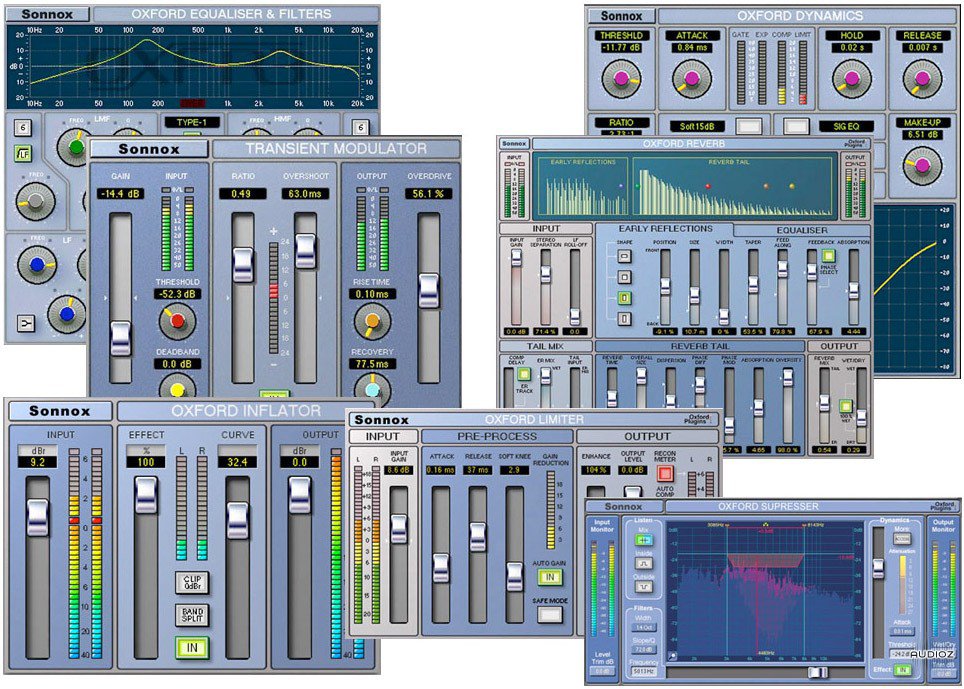
Source Distribution +44 (0)20 8962 5080.
+44 (0)20 8962 5050.